
Style · Braided, twisted or locked
Braids and plaits
One of the oldest ways of dressing hair — and not one style but many, from a school plait tied with a ribbon to cornrows, box braids and ancient braided wigs.
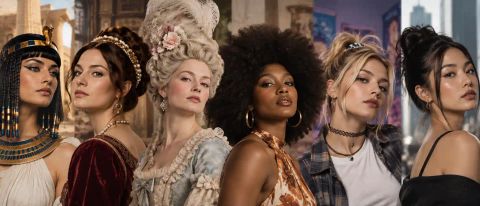
A cultural history · antiquity to today
How women and girls have cut, dressed, covered, coloured, curled, straightened, braided and protected their hair — and what those choices meant at every age.
Hair is both fibre and language: shaped by tools and chemistry, but read through culture.The working proposition of this site
This is not a gallery of “hairstyles by decade”. We look at what people actually wore as well as elite ideals; at girls, teenagers, midlife and older women, not only fashionable young adults; at every hair texture; and at the skilled work — at home and in the salon — behind every style. Every claim is sourced, and we mark what is still being checked.
Independent: not sponsored by any brand, salon or professional body.
From ancient wigs to pandemic haircuts, in 17 overlapping periods.
First haircuts, school plaits, teenage experiments, midlife rules and grey hair.
Bobs, braids, buns and afros — each traced across centuries and communities.
From finished style back to the tools, time and hands that made it.
Styles coexisted, spread unevenly and were revived again and again. These periods are a map for research, not a single line of progress.
Style · Braided, twisted or locked
One of the oldest ways of dressing hair — and not one style but many, from a school plait tied with a ribbon to cornrows, box braids and ancient braided wigs.
Style · Braided, twisted or locked
Rope-like strands formed as hair is allowed or encouraged to mat — worn across many cultures and faiths, and still penalised by some school and workplace rules.
Style · Dressed style
Coily hair worn in its own texture and shaped into a rounded form — a powerful image of pride and politics, and also a style people wore for many other reasons.
Style · Dressed style
A tall, rounded dome of backcombed hair — one of the few styles with a named, dated creator, and a lesson in how a magazine commission could become a decade’s silhouette.
Style · Cut
A family of short cuts whose meanings kept changing — from a 1920s statement to 1960s geometry to a style so familiar it now barely registers.
Style · Dressed style
Hair gathered, coiled and pinned — a form that has meant imperial elegance, respectable adulthood, workplace safety and, lately, deliberate messiness.
Style · Dressed style
Hair gathered and tied at the back of the head — practical for school and sport, a symbol of 1950s teenagers, and a style whose tightness matters.
Style · Dressed style
Hair rolled high at the front and pinned — the style most people now picture for the 1940s, and one of the most revived.
Style · Addition or covering
Added hair is part of hair culture, not "fake hair" — from ancient plaited wigs to Victorian switches, 1960s fashion wigs, extensions and wigs worn through illness.
Essay
Who decides how a girl’s hair is worn, when that power passes to her, and what happens to it again in old age — a history told across a lifetime rather than a decade.
Essay
Most hair work has always been done unpaid, at home, by mothers, sisters, friends and women themselves. This essay follows that labour into the paid salon — a trade, a workplace, a women’s business and a meeting place — mainly in Britain and Ireland, with American and diasporic comparison.
Essay
From suitcases packed with hot combs to Tottenham hair businesses, Brixton salons, Alexandra Palace hair shows and the Halo Code — a history of hair in Black British communities since 1945, told as skill, trade, family time and pleasure as well as struggle.
Essay
From engraved coiffure plates to TikTok, each new medium changed how fast a hairstyle could be seen. This essay follows the channels (prints, photographs, film, fan magazines, trade journals, television and platforms) and asks what evidence could ever show that a famous head caused many others to follow.
Essay
Prisons, poorhouses, hospitals, kitchens, factories, schools and the army have all written rules about women’s and girls’ hair. This essay compares what the rules said with how they were enforced, separates genuine task-specific safety from demands for a particular look, and asks whose natural hair was treated as the problem — mainly in Britain, from the 1840s to today.
Essay
Taps, shampoo, tongs, dryers, perm machines, relaxers, synthetic dyes, plastics and fibres all changed what could be done with hair. This essay asks what each one cost in time, labour and money — and who could afford it — mainly in Britain, with American comparison.
Most fashion histories follow one fashionable young woman. We ask what was expected, allowed and chosen at each stage of life.
Technique · Temporary setting
Shaping wet hair with fingers and a comb into rippling S-shaped ridges — the signature set of the late 1920s and 1930s, and a test of skill.
Technique · Temporary setting
A deep, regular wave made with heated irons — a salon skill that shaped late-Victorian, Edwardian and 1920s hair, and a staple of Black beauty culture.
Technique · Chemical texture change
Changing the shape of hair until it grows out — from hours attached to a heated machine to a cold-wave kit on the kitchen table.
Technique · Temporary setting
Straightening curly and coily hair with a heated comb, and later with chemical relaxers and smoothing treatments — skilled work with a long, contested history.
Technique · Temporary setting
Winding damp hair on rollers and drying it in place — the engine of the weekly "shampoo and set" and of mid-century volume.
Object · c. 1575 BCE to present
Heated metal pincers for curling and waving hair — a tool with a history of more than three thousand years, from Egyptian bronze to the salon Marcel iron.
Object · Prehistoric to present
The most ordinary hair tool, and one of the most revealing — from ancient carved combs to celluloid dressing-table sets, wide-toothed picks and heated pressing combs.
Object · 1880s to present in British collections
From a stoneware bottle of boiling water to the row of humming salon hoods — how drying, the slowest part of every set, was turned into a machine.
Object · Ancient to present
The small, easily lost tool that holds up almost every dressed style in history — from decorated Roman bronze to the mass-produced wire grip.
Object · 1920s onwards; cold-wave kits from the 1940s
A box of lotions, rods and papers that brought the permanent wave out of the salon and into the kitchen — and, in some kits, onto children’s heads.
1869 or 1877 – 1957
Founder of the Poro hair-care company and its training network — a pioneer of Black women’s enterprise often overshadowed in popular memory.
1884–1976
Antoni Cierplikowski, a Polish-born hairdresser who became “Antoine” of Paris — a celebrity salon owner long credited with the first fashionable ladies’ bob, a claim still without contemporary proof.
c. 1920–2003
Ohio cosmetologist who patented a method of weaving added hair onto a client's own hair in 1952, called it the Hair-Weev, and spent four decades teaching it — a founder of modern sewn-in weaving, not the inventor of added hair.
1930–2014
Nigerian photographer whose Hairstyles series, begun in 1968, is one of the richest visual records of women’s hair in any country — made in the years after independence from British rule, and now held in London as well as Paris and New York.
1872–1951
The Black Forest-born hairdresser who, trading in London as “Charles Nestlé”, patented a heated permanent-waving process in 1909 — then rebuilt his business in New York after wartime internment.
1938–2023
Harlem photographer whose pictures of the Grandassa Models and the “Naturally” fashion shows made natural hair a visible ideal of beauty in the early 1960s, and whose images reached Black publications in Britain at the time.
1867–1919
Sarah Breedlove built an influential hair-care company and training network — but she did not invent the hot comb.
1852–1936
The Paris hairdresser whose name became the Marcel wave — a heated-iron wave worn for half a century. The technique’s fame is well documented; much of his life, and the patents often credited to him, are not.
1896–1994
Beautician, teacher and Walker company executive who patented a permanent-waving machine in 1928 and spent half a century training hairdressers — and organising them.
1912?–2008
Harlem beautician and entrepreneur whose Rose Meta House of Beauty was described as the largest Black beauty salon in the world, and who helped found a Black-owned bank in Harlem.
1928–2012
London hairdresser whose precision, geometric cutting made the cut itself the style in the 1960s — and, for some clients, replaced the weekly shampoo and set with a cut every few weeks.
Hair history is unusually open to invention myths, misdated photographs, timelines centred on Europe and claims led by celebrities. We label the evidence behind each claim so you can see the difference, and we would rather tell a few well-evidenced stories than offer a catalogue that looks complete but cannot be trusted.
Research current to 12 November 2026. Read our editorial policy.